
This article was first published in the ISLA Daily 2026 here
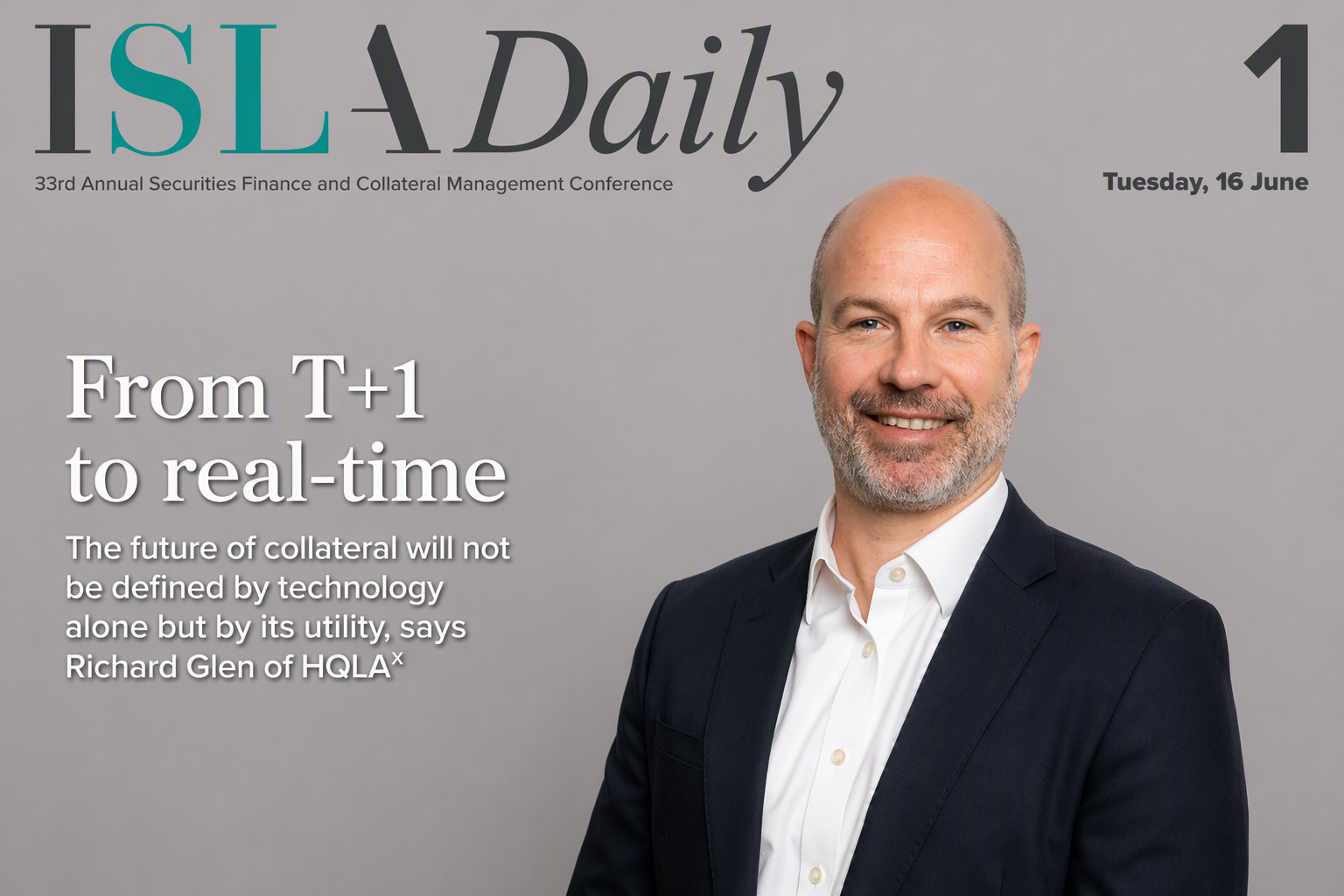
The future of collateral will not be defined by technology alone but by its utility, says Richard Glen, solutions architect at HQLAᵡ, who reviews its execution, solutions, and mobility
Across the treasury and collateral desks of banks and broker-dealers, a growing disconnect is emerging between market ambition and
operational reality. The industry is accelerating towards a T+1 settlement, increasing the theoretical velocity of collateral within and across markets. In practice, however, the ability to mobilise collateral across custodians, jurisdictions, and internal silos remains constrained by legacy infrastructure. Settlement cycles still take hours — or, at times, days.
For desks managing intraday liquidity or optimising scarce collateral resources, this is no longer an operational inconvenience. It is a structural inefficiency with direct economic consequences. Trapped assets, excess buffers, missed optimisation opportunities, and higher funding costs.
This is fundamentally an execution problem, not a technology constraint. Solutions such as those offered by HQLAᵡ already enable the transfer of securities without requiring physical cross-custodian movement. The capability exists. The challenge is consistent, production-level execution within the operating conditions under which Tier-1 and Tier-2 financial institutions operate. A realistic playbook to amplify collateral utility starts with a simple premise — institutions need a practical way to deploy collateral in real time within liquidity, capital, and operational constraints.
This requires focusing on how solutions are delivered within real institutional constraints, rather than assuming idealised transformation programmes. Any approach that fails to align with governance, balance sheet limits, and operational priorities simply will not scale.
Regulatory frameworks, including the Liquidity Coverage Ratio, Leverage Ratio, and intraday liquidity requirements, penalise delays in collateral availability. Where assets cannot be mobilised efficiently across fragmented custody networks, institutions are compelled to hold excess buffers to bridge settlement uncertainty. These buffers are operationally necessary but economically inefficient.
In practice, this translates into material trapped capital. Some institutions have identified opportunities to reduce around €1 billion of buffers through improved collateral mobility, equating to approximately €10 million in annual capital savings.
Crucially, addressing this inefficiency does not require balance sheet expansion. Instead, by enabling precise, point-in-time settlement, collateral can be deployed exactly when required, directly reducing excess buffers while maintaining full alignment with regulatory obligations. This objective is not additional capacity, but better utilisation of existing resources.
Change capacity within large financial institutions is finite. Technology budgets remain under sustained pressure and enterprise IT backlogs often extend over multiple years. In practice, initiatives are filtered through a simple constraint: if delivery depends on deep rewrites of core systems, it is unlikely to progress.
A viable playbook must therefore be non-invasive. By integrating with existing custody and triparty structures, institutions can introduce a synchronisation layer, such as HQLAᵡ , that operates alongside legacy infrastructure. This creates an ‘express lane’ for collateral execution, without requiring changes to core systems while preserving operational continuity. Adoption depends as much on architectural fit as it does on functionality.
The search for a single, decisive cost-saving metric remains persistent and, in most areas, ultimately unrealistic. In modern capital markets, value is rarely delivered through one dominant benefit. The reduction of excess liquidity buffers is one area where more direct benefits may be observed. For firms with structurally high buffers, improved collateral utility may translate into lower capital consumption and measurable cost savings.
More broadly, however, the business case for real-time collateral utility emerges as a portfolio of marginal gains, such as:
• Reduced settlement fails
• Improved collateral allocation
• Lower cross-border settlement costs
• Reduced counterparty credit exposure
• Lower operational risk
Individually, these benefits may appear modest. Assessed over time, they form a clear and durable return on investment. The commercial case should therefore be evaluated as an aggregated outcome, driven by efficiency, optimisation, and risk reduction, rather than a single headline number.
The critical challenge is no longer proving that digital collateral solutions can work. It is embedding them into live operating models at scale.
This shift requires moving beyond controlled pilots and isolated use cases toward repeatable, production-ready workflows that can operate consistently under real market conditions. Success is defined not by technical validation, but by the ability to execute reliably across counterparties, jurisdictions, and time zones.
“The defining innovation of the HQLAᵡ model is the separation of legal ownership transfer from custody movement”
Digital collateral workflows — including delivery-versus-payment (DVP) repo, upgrades and downgrades, and margin processes — must be integrated directly into front-to-back operations. They cannot remain parallel processes. This requires interoperability with incumbent systems, alignment with legal frameworks, and consistency with regulatory expectations. Scale is achieved through integration, not experimentation.
The defining innovation of the HQLAᵡ model is the separation of legal ownership transfer from custody movement. Historically, cross-border or cross-custodian transfers have required physical movement via bridges or bilateral links, introducing latency, time-zone dependencies, and operational risk.
The HQLAᵡ model introduces a fundamentally different paradigm. Assets remain immobilised within existing custody accounts, while legal ownership transfers instantly via a distributed ledger. This eliminates the need for physical movement.
In practical terms, collateral can be mobilised precisely when required rather than pre-positioned in anticipation. The result is a shift from
delayed processes to synchronised and predictable intraday execution.
A defining characteristic of the HQLAᵡ solution is that privacy is composable and embedded at the transaction level. This means data is disclosed strictly on a bilateral basis, with visibility limited to the counterparties involved. Sensitive information, such as asset composition, exposures, and pricing, remains tightly controlled.
This structure aligns with regulatory expectations around data minimisation and client confidentiality, while removing a key barrier to adoption — namely the need to expose sensitive data across a shared network. It also means that institutions can also maintain strict control over proprietary information while participating in shared infrastructure.
Traditional distributed models often require these trade-offs. By design, this architecture avoids them. Privacy, in this context, becomes
an enabler of scale rather than a constraint on participation.
Unlocking meaningful commercial volume does not require immediate large-scale deployment. It depends on establishing repeatable execution through targeted use cases and progressively increasing volume. The 10 COLLATERAL objective with HQLAᵡ is to establish operational confidence through real transactions rather than extended proof-of-concepts. This can be achieved through a focused, sprint-based approach.
The first step is to identify a high-impact, low-complexity use case. Rather than attempting enterprise-wide transformation, success
depends on isolating a defined operational problem:
• Identify a specific corridor where settlement delays are persistent, often cross-custodian or inter-affiliate flows.
• Define a narrow utility asset pool composed of predictable securities.
• Align a focused execution team across trading, operations, and legal.
Precision, rather than scale, is the objective at this stage.
The second sprint establishes the execution layer while maintaining full continuity with existing infrastructure.
• Map custody links ensuring assets remain in their native environments.
• Ensure privacy parameters are aligned with bilateral agreements.
• Execute controlled transactions to validate that legal transfers occur instantly while underlying assets remain static.
The focus is on proving operational integrity without introducing disruption.
The final sprint transitions from validation to commercialisation.
• Execute transactions under existing industry-standard legal frameworks e.g. GMRA, GMSLA, CSA.
• Deploy collateral intraday to capture liquidity opportunities. For example, refinancing US Treasuries swapped for European or Asian equities.
• Begin with modest daily volumes and scale progressively as operational confidence increases.
At this stage, the model moves from capability to full production.
The clearest measure of success is an increase in collateral utility, observed through the transition from multi-hour or next-day settlement
cycles to precise intraday execution windows.
Once legal ownership transfer is decoupled from custody movement:
• Settlement becomes near real-time and predictable.
• Excess buffers are reduced and recycled.
• Cross-custodian movements are reduced or eliminated.
• Manual interventions are replaced by automated, atomic processes.
These outcomes are not theoretical. They represent measurable improvements in how collateral is deployed and managed, improving efficiency across liquidity, capital, and operations.
The transition from T+1 to real-time execution is already underway. Success will favour institutions that execute pragmatically within
existing constraints, rather than those pursuing large-scale transformation programmes or waiting for a definitive business case.
By adopting this focused playbook aligned with existing constraints, realities, and expectations, treasury and collateral teams can deploy
technology solutions such as HQLAᵡ to solve immediate, high value problems.
The future of collateral will not be defined by technology alone but by its utility.


.svg)
